Discover our solutions for challenging environments ↓

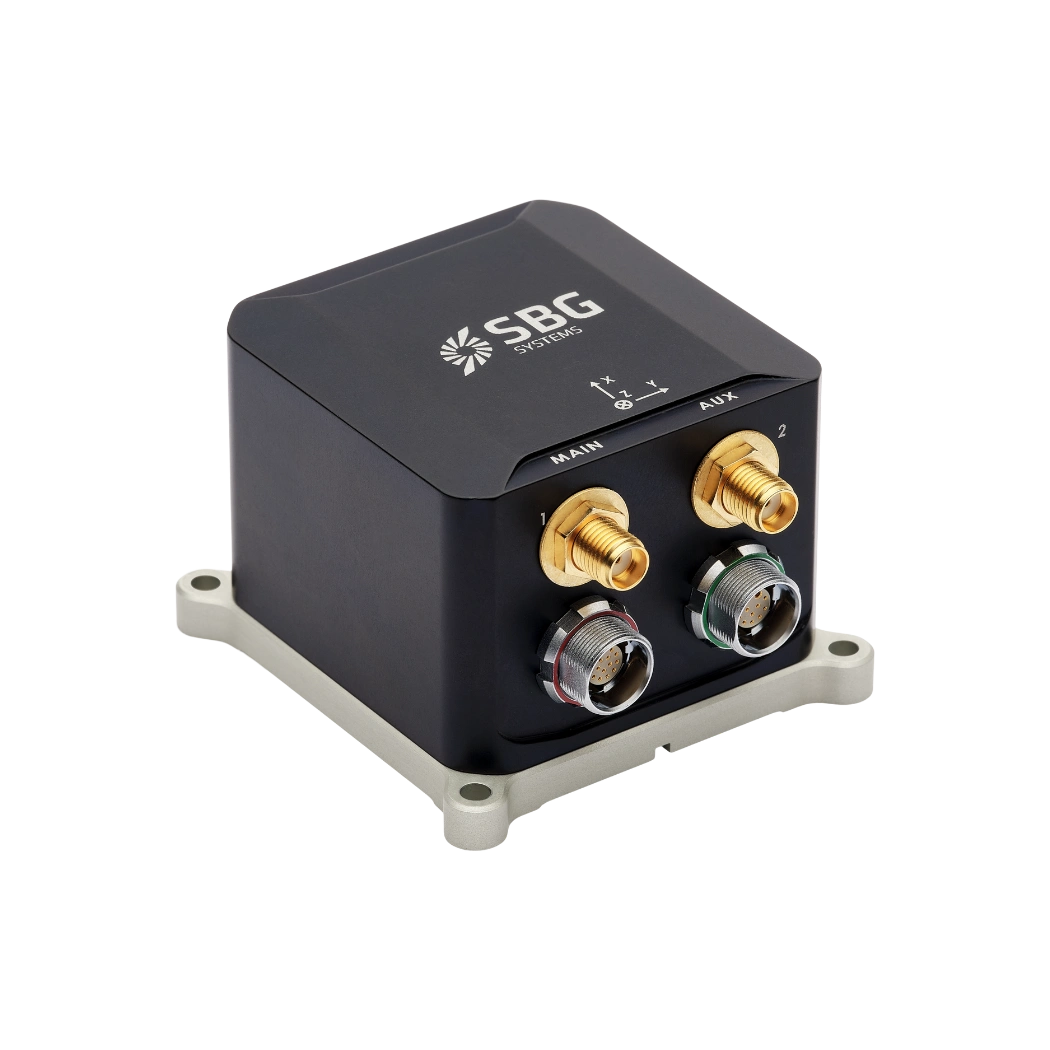

IMU grades

An Inertial Measurement Unit (IMU) consists of three orthogonal gyroscopes and three accelerometers that measure angular velocity ω and specific force f. Manufacturers classify IMUs into performance grades according to sensor error characteristics rather than mechanical construction. These IMU grades determine achievable navigation accuracy, drift rate, and operational environment.
The most important IMU specifications include bias instability, angle random walk (ARW), velocity random walk (VRW), scale factor error, non-linearity, bandwidth, and temperature sensitivity. Gyroscope bias directly influences attitude estimation, while accelerometer bias produces position drift after double integration.
Position error approximately follows:
where ba is accelerometer bias and t is elapsed time.
Automotive IMU
An automotive IMU prioritizes cost, robustness, and high-volume manufacturing. An automotive IMU sensor typically supports vehicle dynamics, electronic stability control, dead reckoning, and advanced driver assistance systems. An automotive-grade IMU delivers sufficient accuracy for short GNSS outages while maintaining low power consumption.
Industrial-grade IMU
The industrial-grade IMU offers improved bias stability and environmental resistance. Understanding the industrial grade meaning helps engineers balance performance, reliability, and cost for robotics, mapping, marine, and automation systems. When asking what is industrial grade, the answer generally refers to sensors designed for continuous operation under demanding industrial conditions.
Tactical-grade IMU
A tactical-grade IMU provides significantly lower bias instability, often below 1°/h for gyroscopes, enabling accurate navigation during extended GNSS-denied operation.
Modern navigation MEMS IMU technology has narrowed the performance gap between traditional fiber-optic systems and MEMS devices.
Navigation-grade IMU
A navigation-grade IMU integrates precision sensors with advanced calibration and compensation algorithms to minimize deterministic and stochastic errors. These systems commonly support autonomous vehicles, hydrography, airborne surveying, and defense applications.
Strategic-grade IMU
The highest-performance category is the strategic-grade IMU or strategic-grade inertial sensor. These systems achieve extremely low drift through ultra-stable gyroscopes, rigorous thermal control, and extensive calibration. They support submarine, missile, spacecraft, and long-duration autonomous navigation missions.
Ultimately, selecting the appropriate IMU depends on required navigation accuracy, mission duration, environmental conditions, and cost. Matching sensor performance to application ensures the optimal balance between performance, reliability, and system complexity.