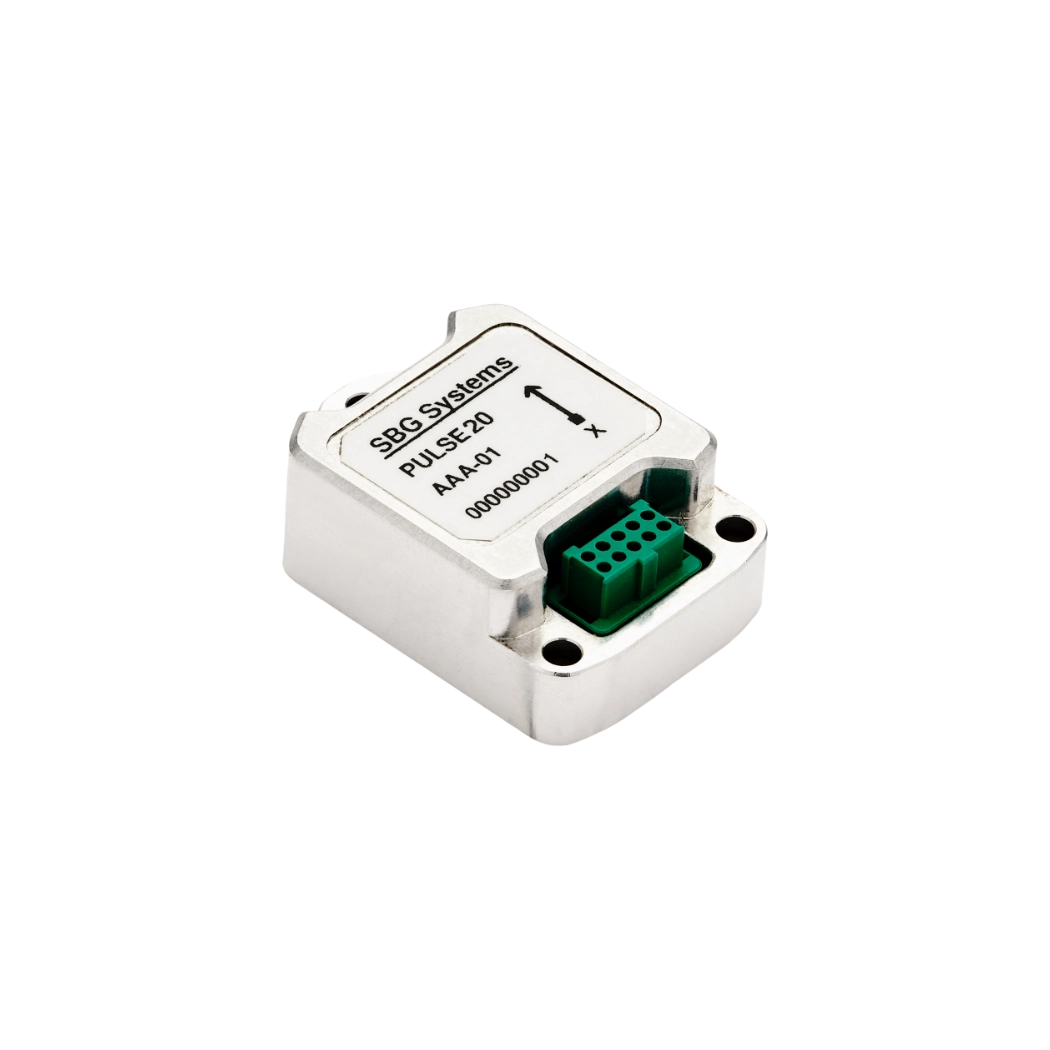
Industrial-grade IMU
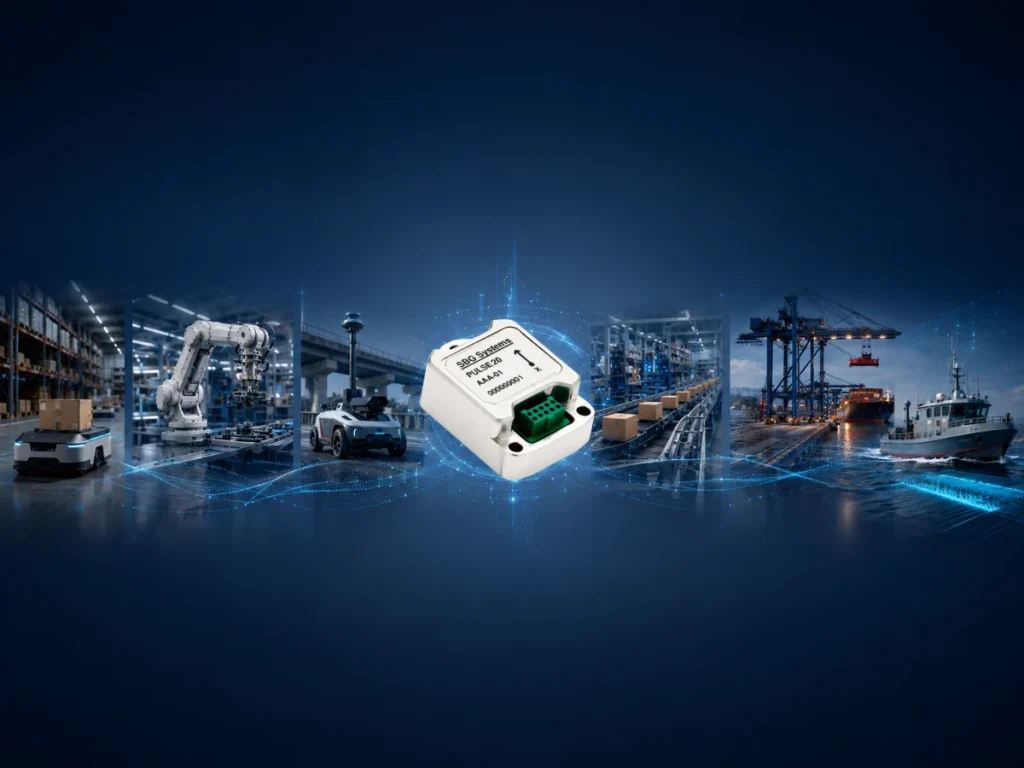
An industrial-grade IMU is a motion sensor that measures three-axis angular velocity and three-axis linear acceleration. Compared with consumer-grade devices, it delivers higher accuracy, stability, and durability. It combines three MEMS gyroscopes and three MEMS accelerometers in a calibrated package. As a result, it operates reliably in harsh industrial environments.
Industrial-grade IMUs typically achieve gyroscope bias instability between 1 and 10°/h. In addition, angle random walk usually ranges from 0.1 to 0.5°/√h. Accelerometer bias commonly falls between 0.1 and 1 mg, depending on sensor architecture and calibration quality. Consequently, these characteristics enable stable attitude estimation and reliable dead-reckoning during short GNSS outages.
Manufacturers optimize industrial-grade IMUs for long-term repeatability instead of maximum navigation accuracy. Therefore, advanced factory calibration compensates for scale factor errors, axis misalignment, temperature drift, and sensor nonlinearity. Moreover, calibration remains effective across a wide operating temperature range. Many industrial-grade IMUs also integrate vibration filtering and built-in self-test functions. Furthermore, high sampling rates preserve measurement quality under highly dynamic operating conditions.
Industrial-grade IMUs serve as the core sensing element of an AHRS or an INS. They provide inertial data for fusion with GNSS, LiDAR, wheel encoders, cameras, odometers, or Doppler Velocity Logs (DVLs). As a result, sensor fusion improves positioning robustness, attitude estimation, and vehicle control. It also maintains navigation performance when external references degrade or become temporarily unavailable.
Engineers widely deploy industrial-grade IMUs in mobile robotics, autonomous mobile robots (AMRs), mobile mapping systems, marine platforms, automated guided vehicles (AGVs), cranes, conveyor systems, industrial machinery, and precision automation. Therefore, they offer an effective balance between performance, robustness, power consumption, and cost. As a result, they suit demanding industrial motion control and navigation applications.