
Seeker
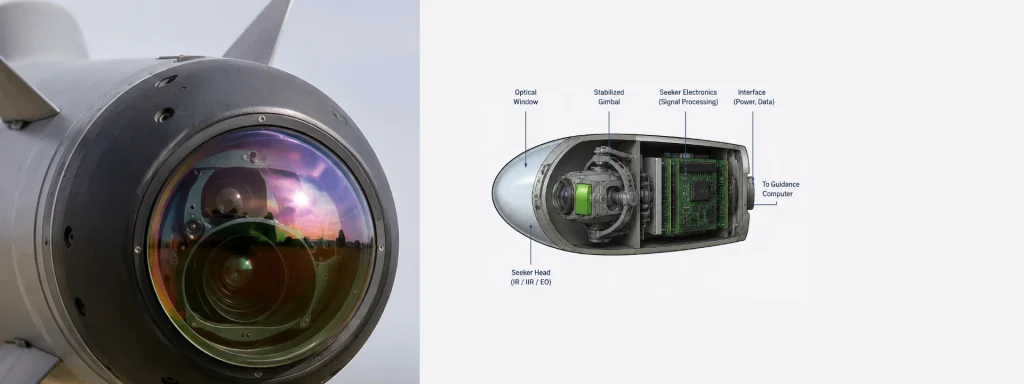
A seeker is the terminal guidance subsystem of a guided vehicle. It detects, tracks, and updates target’s relative position during the final flight phase. Unlike an Inertial Navigation System (INS), this subsystem measures the target’s line-of-sight (LOS). It then sends this information to the guidance computer. The guidance computer uses the data to generate accurate steering commands. The application is also referred to as Seeker Stabilization and Control.
Mission requirements determine the choice of seeker technology. Infrared (IR) seekers detect thermal emissions from heat-generating targets. They operate passively and reduce the risk of detection.
Electro-optical (EO) seekers work in the visible spectrum. They provide high-resolution imagery for target recognition in good lighting conditions.
Active radar seekers transmit radio-frequency signals and process the reflected echoes. They support long-range target acquisition in all weather conditions. Semi-active radar systems depend on external radar illumination. Laser systems track laser energy reflected from designated targets.
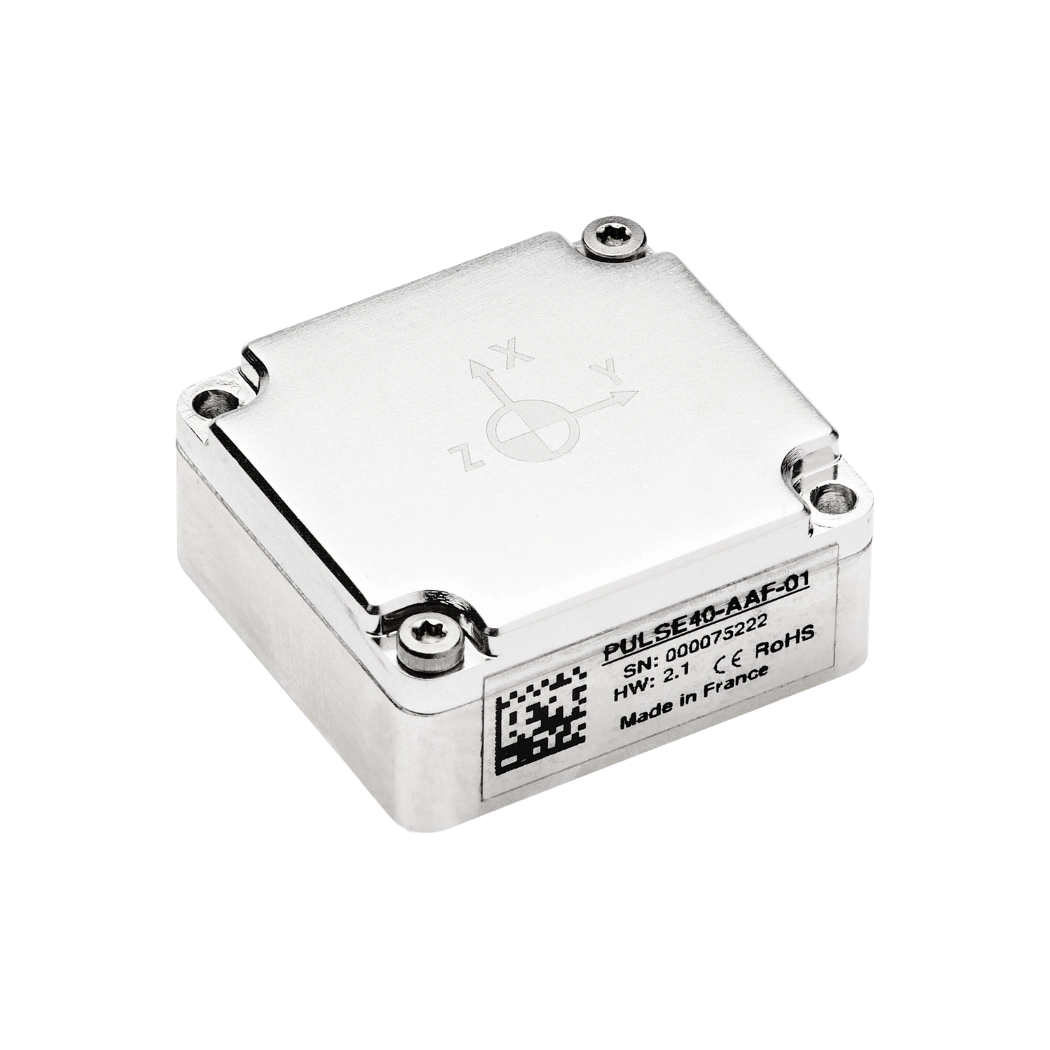
Sensor quality alone does not determine seeker performance. Stabilization accuracy also plays a critical role. High-performance IMUs measure angular rates and linear accelerations at high bandwidth. These measurements stabilize the line of sight during dynamic maneuvers. They also compensate for platform motion and external disturbances. As a result, the seeker maintains accurate target tracking throughout the engagement.
Modern guidance systems combine seeker measurements with inertial navigation data. They use advanced sensor fusion algorithms, including the EKF. These algorithms improve target tracking accuracy and reduce measurement noise. They also maintain guidance when the target becomes temporarily obscured or sensor performance decreases.
Modern battlefields demand greater precision and resilience. Advanced seekers and high-performance inertial sensors work together to meet these requirements. Their integration improves guidance accuracy and mission effectiveness. It also increases resistance to countermeasures in contested environments.