Explore our solutions for high-dynamic maneuvers ↓

Gyroscope range
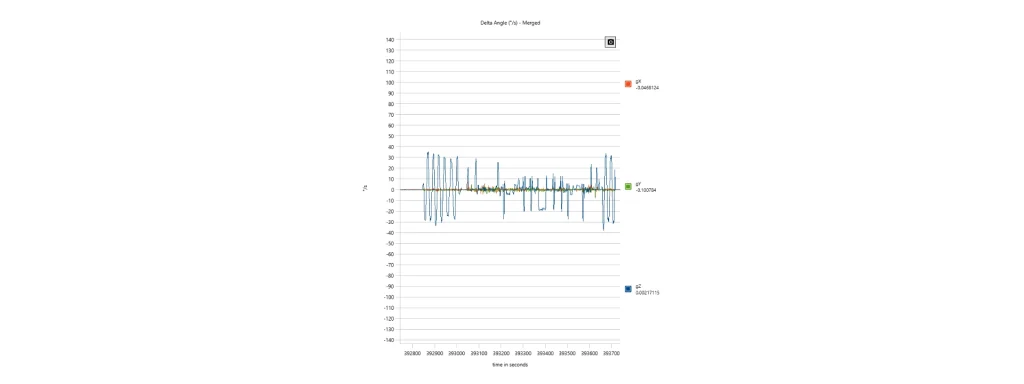
Gyroscope range defines the maximum angular velocity that a gyroscope can measure while maintaining linear operation. It is typically specified in degrees per second (°/s) or radians per second (rad/s), with common values ranging from ±50°/s for precision stabilization to ±2,000°/s or higher for high-dynamic applications such as missiles, UAVs, or automotive crash testing.
The selected measurement range directly influences the sensor’s ability to capture rotational dynamics. When the applied angular rate exceeds the specified range, the gyroscope saturates, resulting in clipped measurements and the loss of angular information. This saturation propagates through attitude estimation algorithms and inertial navigation computations, leading to increasing orientation and position errors.
The gyroscope outputs the measured angular rate, which can be expressed as:
where ω is the true angular velocity, b is the gyro bias, and n represents measurement noise. The measured angular velocity is integrated over time to estimate orientation:
Any measurement error introduced by saturation, bias, or noise accumulates through this integration process, emphasizing the importance of selecting an appropriate range.
Increasing the gyroscope range generally reduces sensitivity because the analog-to-digital converter distributes its quantization levels across a wider measurement span. For an N-bit converter, the angular resolution can be approximated as
where ωmax is the full-scale angular rate. Increasing the full-scale range increases the minimum detectable angular increment unless the converter also increases its resolution.
The importance of choosing the best solution
Choosing the optimal gyroscope range requires balancing dynamic capability and measurement precision. Low-dynamic applications, including platform stabilization and hydrographic surveying, benefit from narrow ranges that maximize resolution and minimize noise. Conversely, highly dynamic systems such as tactical UAVs, guided munitions, and autonomous racing vehicles require wider ranges to prevent saturation during rapid rotational maneuvers.
Modern tactical-grade MEMS gyroscopes often incorporate programmable measurement ranges and adaptive signal conditioning, allowing a single sensor architecture to satisfy multiple mission profiles while preserving high bias stability, low angle random walk, and excellent scale factor accuracy.