DoF – Degrees of Freedom
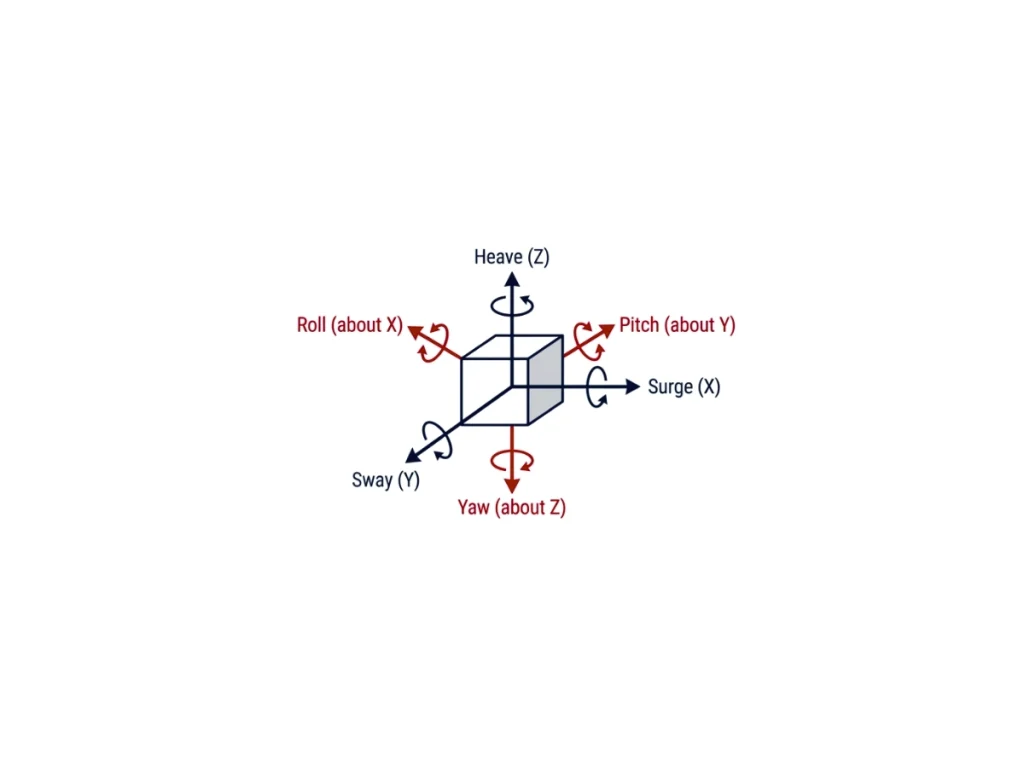
A Degrees of Freedom or DoF model describes the number of independent variables required to completely define the motion of a body. In inertial navigation, DoF models establish the mathematical framework used to represent translation, rotation, and the dynamic behavior of a platform. They directly influence motion equations, sensor fusion algorithms, state estimation and navigation accuracy.
The simplest models describe motion along a single axis. A 1-DoF model represents either one translational or one rotational motion and is commonly used for vibration analysis or single-axis stabilization. 2-DoF and 3-DoF models extend this concept by introducing multiple translational or rotational axes. A 3-DoF rotational model, estimates roll, pitch, and yaw using gyroscopes, accelerometers, and optionally magnetometers, making it suitable for attitude estimation in AHRS systems.
The 6-DoF rigid-body model is the industry standard for inertial navigation. It combines three translational motions (surge, sway, and heave) with three rotational motions (roll, pitch, and yaw), enabling complete three-dimensional motion representation. Modern IMUs measure angular velocity and specific force along these six axes, while INS algorithms integrate these measurements to estimate position, velocity, and attitude through sensor fusion techniques such as the Extended Kalman Filter (EKF).
More advanced applications use 7- to 15-DoF models. These models include additional dynamic states or articulated bodies. They also represent suspension systems, steering mechanisms, and coupled rigid bodies. Engineers use them in robotics, automotive, aerospace, and marine simulations. They improve dynamic realism but increase computational complexity. They also require more advanced estimation algorithms.
Selecting the appropriate DoF model depends on the application requirements. Vehicle dynamics and available sensors also influence the choice. Engineers must balance computational efficiency with navigation accuracy. Higher DoF models provide greater fidelity. However, they require sufficient sensor information and accurate physical models.