
Tight coupling
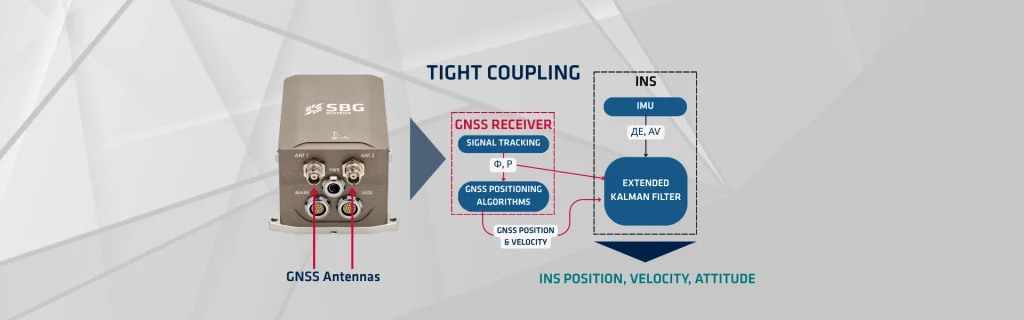
Tight coupling represents an advanced data fusion strategy critical for robust and high-accuracy Global Navigation Satellite System (GNSS) and Inertial Navigation System (INS) integration. This approach combines the strengths of both systems—long-term stability from GNSS and high-rate, short-term precision from INS—by fusing their core measurements directly within a single estimator, typically a Kalman Filter. Performance improves dramatically, especially when GNSS signals are partially blocked or degraded.
GNSS receivers determine position by measuring the time signals travel from multiple satellites. This process yields absolute position fixes with accuracy depending on satellite visibility and geometry. However, GNSS is susceptible to signal outages in environments like urban canyons or forests, leading to data gaps and navigation loss (drift).
Tightly coupled systems use measurements of aiding signal parameters to mitigate drift in an INS. Compared to loosely coupled systems, tight coupling update the error states of the INS, even when insufficient GNSS data prevents fixing a position. This situation occurs when fewer than four GNSS satellites are visible, making it impossible to determine a position solution using solely GNSS information.
In loosely coupled systems, this situation causes a complete data outage. However, tightly coupled systems can use limited GNSS measurements, allowing them to partially mitigate the INS error drift.
To achieve this objective, tightly coupled systems must calibrate the IMU (Inertial Measurement Unit) in real-time, focusing particularly on periods when the GNSS signal is unobstructed. This calibration ensures precise knowledge of the IMU bias and trains the IMU to anticipate the GNSS signal’s future location (anticipatory modelling).
By enabling the IMU to evaluate the GNSS signal’s validity and precision and select the GNSS signal that corresponds to its prediction, the system establishes a strong connection between the IMU and GNSS.
The tight coupling architecture
The core concept of tight coupling is to use the GNSS pseudorange and carrier phase measurements directly in the Kalman Filter observation update step. This is a significant departure from loose coupling, where the Kalman Filter uses the fully processed, standalone GNSS position and velocity solution.
In a tightly coupled system, the Kalman Filter’s state vector typically includes the INS error states:
- Position errors (δr)
- Velocity errors (δv)
- Attitude errors (δ𝛙)
- IMU sensor biases (accelerometer and gyroscope)
The Kalman Filter uses the INS mechanization equations for the time-propagation (prediction) step. This propagates the INS states forward using the high-rate IMU data.
Advantages of tight coupling
Tight coupling offers several powerful benefits, particularly for post-processing applications where all sensor data is available after the mission. Unlike loose coupling, which requires a solution from at least four GNSS satellites to compute a 3D position, tight coupling only needs one visible satellite. With a single pseudorange measurement, the Kalman Filter can still derive an error correction vector that effectively restrains the INS drift. This capability is vital in partially obstructed areas.
By utilizing the raw GNSS measurements, the filtering can directly model and estimate the GNSS receiver clock bias within the state vector. This deep level of integration leads to a more accurate and precise overall navigation solution, especially when combining carrier phase measurements for Real-Time Kinematic (RTK) or Precise Point Positioning (PPP) post-processing techniques.
The seamless, integrated correction process ensures a smoother and more consistent navigation quality. The algorithms optimally weights the high-precision INS data with the often-noisy GNSS observations. During GNSS outages, the well-calibrated INS (due to continuous bias estimation) provides a superior dead-reckoning solution.
Post-processing involves forward and backward filtering. The data is first processed chronologically (forward filter). Then, a backward filter processes the data in reverse, using the final forward estimates as initial conditions. A fixed-interval smoother (e.g., Rauch-Tung-Striebel smoother) smooths the results from both filters. This smoothing step delivers the most accurate, statistically optimal trajectory solution, leveraging all available data across the entire mission timeline. This makes tight coupling a gold standard for high-accuracy applications like mapping and surveying.