
Position drift
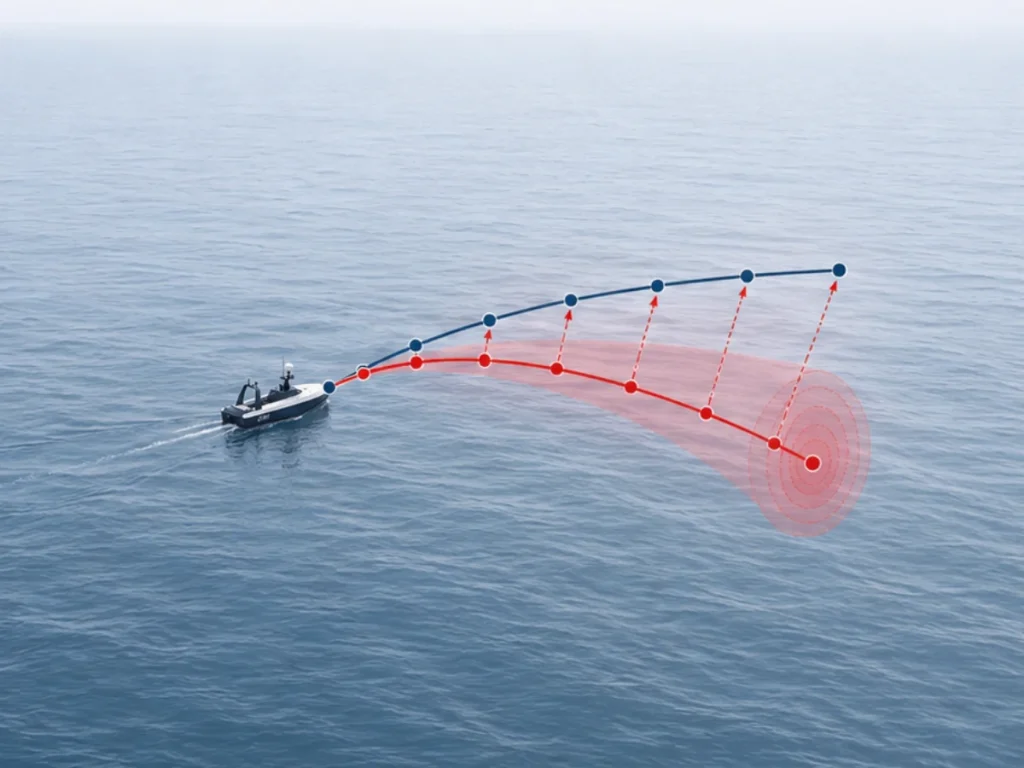
Position drift is the progressive growth of position error in an inertial navigation system (INS) as it estimates a vehicle’s trajectory over time. An INS computes position by integrating acceleration measurements from an inertial measurement unit (IMU). Since integration amplifies sensor errors, even small measurement biases generate increasing navigation uncertainty.
An IMU measures specific force and angular velocity using accelerometers and gyroscopes. The navigation algorithm transforms these measurements from the sensor frame into the navigation frame using attitude estimation. The INS then integrates acceleration to calculate velocity and integrates velocity to calculate position:
Because position requires a double integration of acceleration, small errors create significant drift. For example, a constant accelerometer bias produces a velocity error that increases linearly with time:
The resulting position error grows quadratically:
Gyroscope errors also contribute to position drift. Small attitude errors misproject the gravity vector into the horizontal plane, generating false accelerations that increase navigation errors over time. Sensor bias instability, noise density, scale factor errors, misalignment, temperature changes, vibration, and calibration quality all influence drift growth.
High-performance tactical and navigation-grade IMUs reduce these effects through precise calibration and advanced error compensation. Modern INS solutions further limit drift by integrating inertial measurements with aiding sources such as GNSS, odometry, Doppler Velocity Log (DVL), or visual navigation.
Advanced estimation algorithms (e.g. EKF) continuously estimate sensor errors, improving navigation accuracy and extending autonomous positioning performance during prolonged GNSS outages.