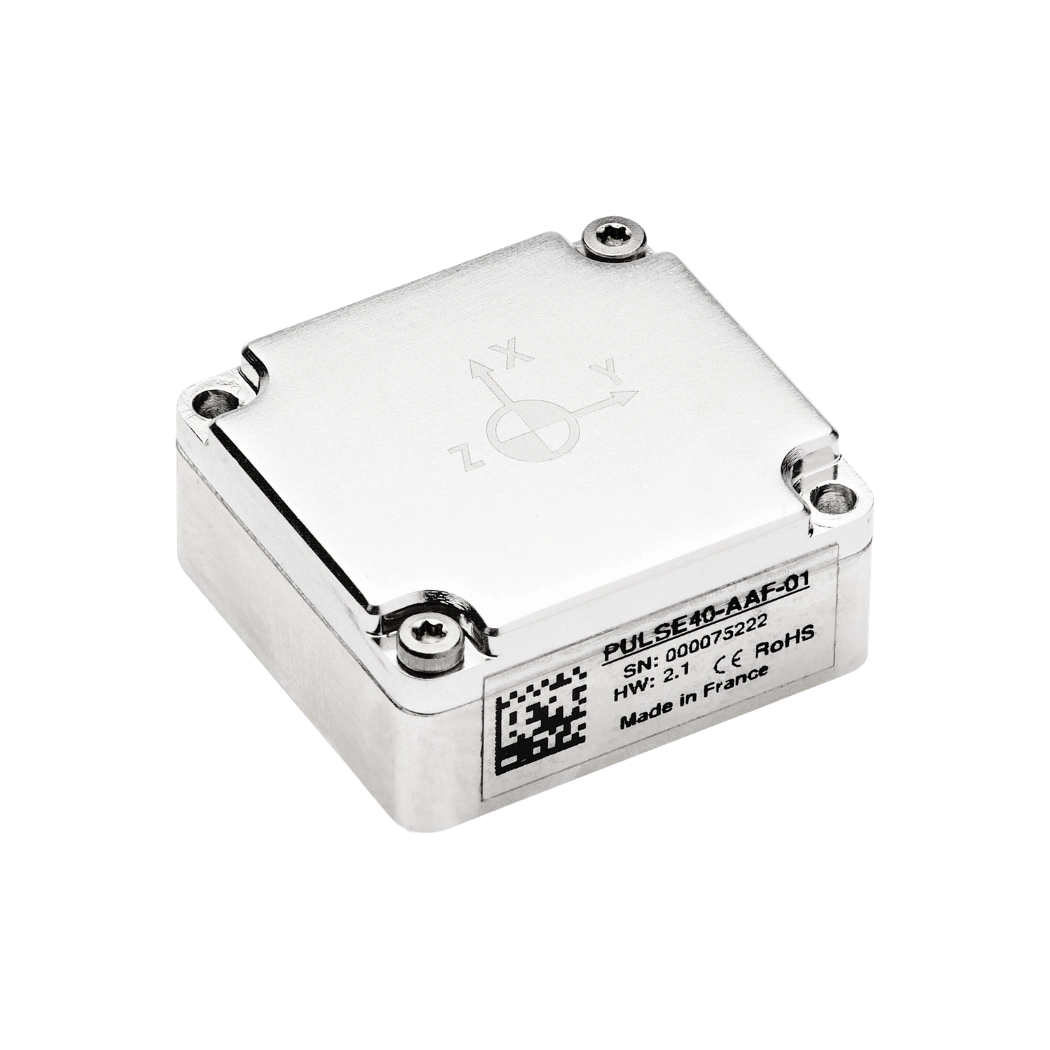


MEMS inertial sensors
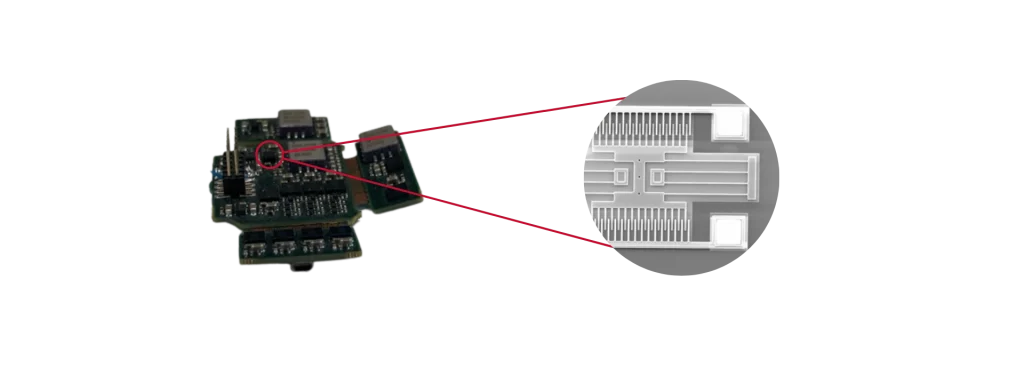
MEMS inertial sensors measure linear acceleration and angular rate using microfabricated mechanical structures etched on silicon wafers. Semiconductor manufacturing ensures high repeatability, excellent scalability, and consistent sensor performance. Consequently, manufacturers achieve compact dimensions, lower production costs, and high reliability.
A MEMS Inertial Measurement Unit (IMU) integrates three orthogonal accelerometers and three gyroscopes. Together, these sensors measure motion across six degrees of freedom (6-DoF). However, an MEMS IMU alone cannot estimate position or heading. Therefore, manufacturers integrate GNSS receivers, magnetometers, odometers, or other aiding sensors. Sensor fusion algorithms then generate reliable navigation and orientation estimates. As a result, the system operates as an Attitude and Heading Reference System (AHRS) or a complete Inertial Navigation System (INS).
Several parameters define MEMS inertial sensor performance. These include bias instability, Angle Random Walk (ARW), Velocity Random Walk (VRW), scale factor accuracy, bandwidth, vibration rejection, and thermal stability. Furthermore, factory calibration compensates for deterministic sensor errors. These errors include axis misalignment, scale factor nonlinearity, g-sensitivity, and temperature-dependent bias variations. Subsequently, embedded Extended Kalman Filters (EKF) fuse inertial measurements with external observations. This process continuously estimates sensor errors and reduces inertial drift. Consequently, the navigation solution maintains higher accuracy during dynamic operations.
Recent advances have significantly improved MEMS inertial technology. For example, closed-loop sensing architectures increase linearity and reduce bias sensitivity. Likewise, improved MEMS fabrication enhances repeatability and long-term stability. Advanced digital signal processing also improves noise performance and vibration robustness. As a result, high-end MEMS sensors now achieve tactical-grade performance. Meanwhile, they remain smaller, lighter, and more power-efficient than traditional inertial technologies. Therefore, engineers increasingly select MEMS sensors for autonomous vehicles, robotics, hydrography, mobile mapping, precision agriculture, and defense navigation systems.