Explore our solutions for high-dynamic maneuvers ↓

Accelerometer
An accelerometer is an inertial sensor that measures specific force, defined as the non-gravitational acceleration acting on an object. Unlike a speed sensor, an accelerometer does not directly measure velocity or position. Instead, it detects changes in motion along one, two, or three orthogonal axes by measuring the force applied to an internal sensing element.
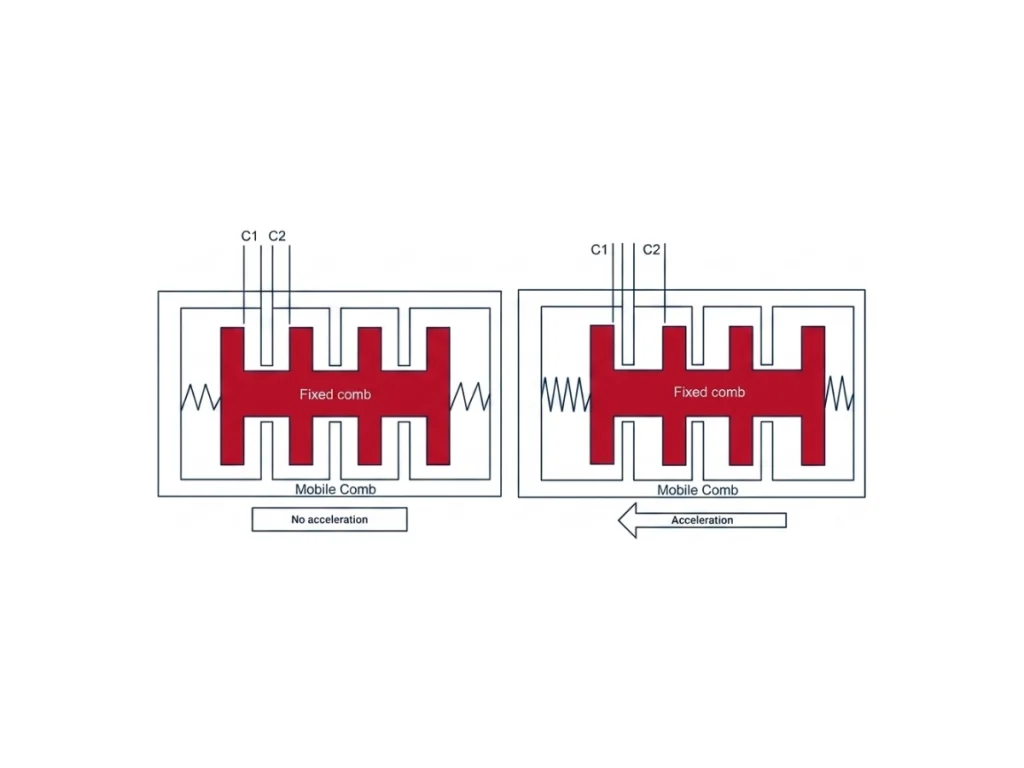
Modern accelerometers are predominantly based on Micro-Electro-Mechanical Systems (MEMS) technology. A MEMS accelerometer contains a microscopic proof mass suspended by flexible structures. When the sensor experiences acceleration, the proof mass displaces relative to the sensor frame. Capacitive, piezoresistive, or piezoelectric transducers convert this displacement into an electrical signal proportional to the applied acceleration.
Accelerometers measure both dynamic acceleration, generated by movement or vibration, and static acceleration, resulting from Earth’s gravitational field. This capability enables them to estimate tilt angles under static conditions while simultaneously detecting rapid changes in motion. Their measurement range typically extends from a few g to several hundred g, depending on the application, while performance characteristics such as bias stability, noise density, scale factor accuracy, bandwidth, and temperature stability determine measurement quality.
In inertial navigation systems, accelerometers work alongside gyroscopes to estimate velocity and position through continuous integration of acceleration data. Sensor fusion algorithms, such as Extended Kalman Filters (EKF), combine accelerometer measurements with GNSS, magnetometers, odometers, LiDAR, or vision sensors to improve navigation accuracy and robustness in GNSS-denied environments.
Today, accelerometers are essential components in aerospace, defense, autonomous vehicles, marine navigation, mobile mapping, industrial automation, structural monitoring, and robotics. Their compact size, low power consumption, and high reliability make MEMS accelerometers the preferred solution for modern motion sensing applications, where accurate acceleration measurements form the foundation of precise navigation and control.