Magnetometer
A magnetometer is a three-axis sensor that measures the direction and magnitude of the surrounding magnetic field. In inertial navigation, it primarily detects the Earth’s magnetic field to estimate the heading relative to magnetic north. It provides an absolute orientation reference that limits long-term heading drift during sensor fusion.
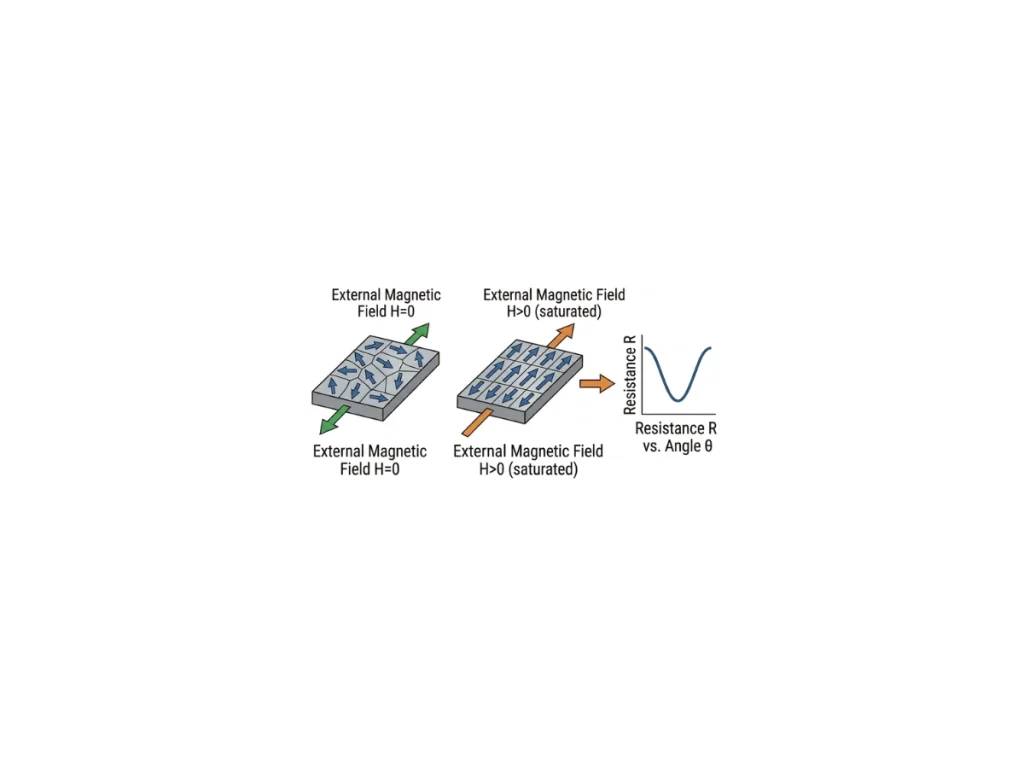
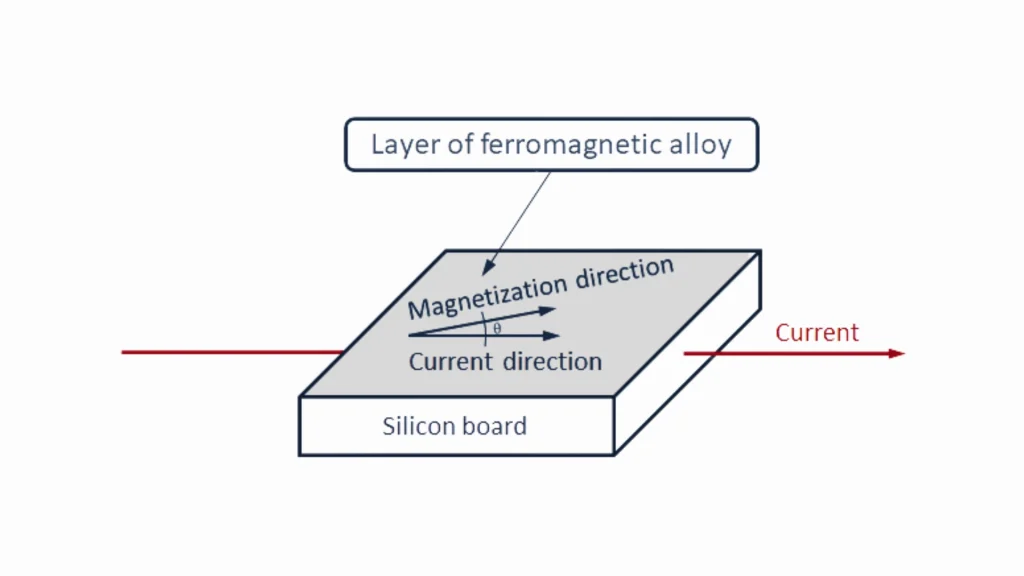
Most modern inertial systems integrate MEMS magnetometers based on technologies such as Anisotropic Magneto-Resistance (AMR), Hall Effect, or Fluxgate sensing. AMR sensors deliver high sensitivity, excellent bias stability, low power consumption, and compact dimensions for navigation applications. They measure the magnetic field along three orthogonal axes to produce a three-dimensional magnetic vector. Although magnetic field strength is commonly expressed in microteslas (µT), milligauss (mG), or nanoteslas (nT), navigation algorithms mainly rely on the vector direction rather than its absolute magnitude.
The Earth’s magnetic field is relatively weak, typically ranging from approximately 250 to 650 mGauss depending on geographic location. Nearby magnetic sources can easily distort this field. Permanent magnets and current-carrying conductors generate hard-iron disturbances that shift the measured magnetic vector, while ferromagnetic structures create soft-iron distortions that deform its shape. These effects can exceed the Earth’s magnetic field by several orders of magnitude and significantly degrade heading accuracy. Consequently, accurate magnetic calibration is essential to identify and compensate for local disturbances before reliable heading estimation becomes possible.
Modern sensors algorithms cannot determine complete orientation using only a magnetometer. They fuse magnetometer, gyroscope (short-term angular motion with high precision), and accelerometer (gravity vector to calculate roll and pitch) measurements through an EKF. Magnetometers provide an absolute heading reference relative to magnetic north. This sensor fusion minimizes gyroscope drift and improves long-term heading accuracy. This approach is used in surveying, marine, industrial systems and autonomous vehicles.