
Ambiguity Resolution
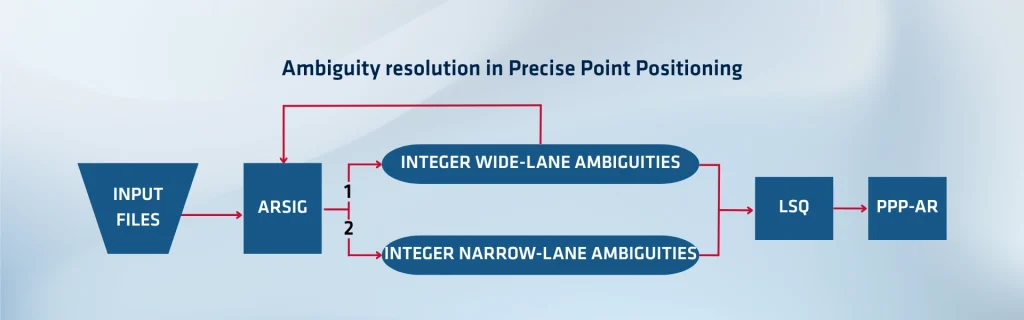
Precise Point Positioning (PPP) gives a user high-accuracy position by modeling satellite orbits, clocks, atmospheric delays, and other error sources. Yet standard PPP often converges slowly—sometimes tens of minutes to hours—because it treats the carrier-phase ambiguities as floating (real valued) unknowns. Ambiguity resolution (AR) in PPP (often called PPP-AR) accelerates convergence and improves accuracy by recovering the integer nature of those ambiguities.
Carrier-phase ambiguities are naturally integers, but in real GNSS data they lose their strict integer property because instrumental biases at satellites and receivers add fractional offsets. These delays—called Uncalibrated Phase Delays (UPDs) or fractional cycle biases—constitute unknown biases that smear the integer nature of ambiguities.
A float‐ambiguity solution absorbs these biases and yields a noninteger estimate of ambiguity. For PPP-AR, the system must estimate and remove or correct the biases, recovering an integer ambiguity that the user can fix to its integer value reliably.
Estimating the biases via a network
To resolve ambiguities, PPP-AR systems often build a network of reference stations across the globe (or a regional network). Each station tracks multiple satellites and collects raw GNSS observations. The idea is to pool data from many stations so that one can estimate the biases (UPDs) as common parameters affecting multiple links.
The system first runs a “float PPP” to estimate ambiguous phase values at all network stations. Then it formulates a linear system to solve for satellite and receiver biases simultaneously, treating one reference station’s bias as zero to anchor the solution.
Network computes these biases in near real time (e.g. updating every 15 minutes) with low latency (on the order of an hour or less) so users can apply them quickly. The SBG solution described in the paper delivers UPDs with under one hour latency.
Applying ambiguities in a rover
On the user side, the rover receives the UPD corrections (satellite biases) and applies them to its float-ambiguity estimates. By subtracting the bias, the system recovers an ambiguity estimate that is (ideally) close to an integer. The receiver can then perform a robust integer estimation (using methods like the LAMBDA method or other integer least squares) to fix the integer ambiguity. With fixed integers, the PPP solution gains in precision and converges much faster.
Importantly, the quality control of fixing is critical: if the residuals (difference between float and fixed ambiguity) exceed some threshold (usually a fraction of a cycle), the fix is rejected. Integrity checks thus guard against wrong fixes that would degrade the solution.
Integrity control and ongoing stability
A PPP-AR system must constantly monitor the quality of its bias estimates and ambiguity fixes. The network side runs checks on standard deviations, residuals, base station coverage, and stability of bias values over time. It also cross-validates by selecting a subset of stations as “control” stations: it runs the PPP-AR using those bias products and compares the result to known reference positions. If deviations stay within centimeter bounds, the products are deemed trustworthy; otherwise, the system flags or rejects biases or satellites.
On the rover side, the receiver monitors residuals of fixed vs float ambiguities, satellite health, and solution consistency to avoid error propagation.
Benefits and performance
By resolving ambiguities, PPP-AR typically converges in a few minutes or less (versus tens of minutes in float-only PPP). It also yields better positioning precision, often at the centimeter level in both horizontal and vertical axes. The SBG case showed horizontal RMS errors around 1–2 cm after convergence for test base stations.
SBG Systems
Because bias estimation runs continuously, PPP-AR can serve “near real-time” users, making it suitable for precise applications in surveying, autonomous navigation, geodesy, and more. The main trade-off lies in building and maintaining a robust network infrastructure, ensuring interoperability and integrity, and handling data latency and interruptions.
Ambiguity resolution in PPP (PPP-AR) works by estimating and removing fractional biases (UPDs) via a network of reference stations, then applying integer fixing at the rover to accelerate convergence and increase precision. Critical to success are robust bias estimation, integrity monitoring, and real-time delivery of corrections to users.
Discover Orbi AR, our own Ambiguity Resolution in Precise Point Positioning technology tool. We developed this technologyt o deliver centimeter-level accuracy without relying on a local base station. Unlike RTK, which requires a base station within a limited range to provide corrections, Orbi AR achieves global coverage by using precise satellite orbit, clock, and atmospheric models. This makes it possible to obtain highly accurate positions anywhere in the world—even in remote regions such as oceans, deserts, or mountainous terrain.