
QZSS: Quasi-Zenith Satellite System
The Quasi-Zenith Satellite System (QZSS) is a critical Japanese satellite navigation system. It is also known as Michibiki. QZSS enhances the US-operated Global Positioning System (GPS). It provides high-accuracy positioning services. QZSS is distinct from traditional Global Navigation Satellite Systems (GNSS). Its primary focus is on regional augmentation.
How does QZSS work?
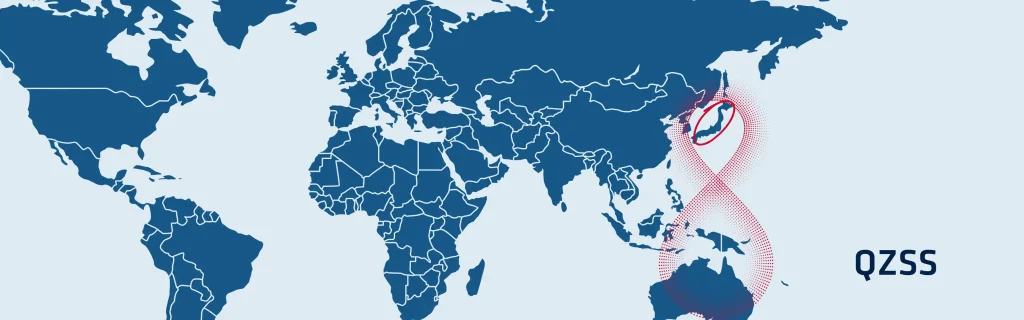
QZSS employs a constellation with unique orbital characteristics. It uses a mix of Medium Earth Orbit (MEO) and Inclined Geosynchronous Orbit (IGSO) satellites. The current configuration includes four main satellites. Three satellites operate in IGSO at an inclination of about 43º. These IGSO satellites trace a specific, asymmetrical figure-eight path. This path ensures at least one satellite remains near the zenith over Japan. This high elevation minimizes signal blockage. The fourth satellite is placed in a GEO or a slightly different MEO orbit. The overall constellation ensures at least one satellite is visible. This visibility remains high above the horizon.
QZSS operates as a Satellite-Based Augmentation System (SBAS). It broadcasts correction data and health information. This augmentation significantly improves positional accuracy. It enhances the reliability of the GPS signal. The Quasi-Zenith Satellite System transmits its own independent signals, too. These signals are compatible with GPS signals. This ensures interoperability with existing receivers. Users receive signals from both GPS and QZSS. This dual reception geometry strengthens the fix. It delivers positioning accuracy down to a few centimeters.
The system broadcasts signals across multiple L-band frequencies. These include the common GNSS signals like L1C/A, L1C, L2C, and L5. Crucially, QZSS transmits a sub-meter level correction signal on the L6 band. This enables the Centimeter Level Augmentation Service (CLAS).
CLAS provides high-accuracy positioning for various applications. This technical capability supports autonomous driving and surveying. Additionally, QZSS broadcasts an important safety message called L1-SAIF. The dual-frequency and multi-signal structure ensures robust and precise PNT.
The Quasi-Zenith Satellite System significantly strengthens Japan’s regional spatial information infrastructure.