Electromagnetic warfare
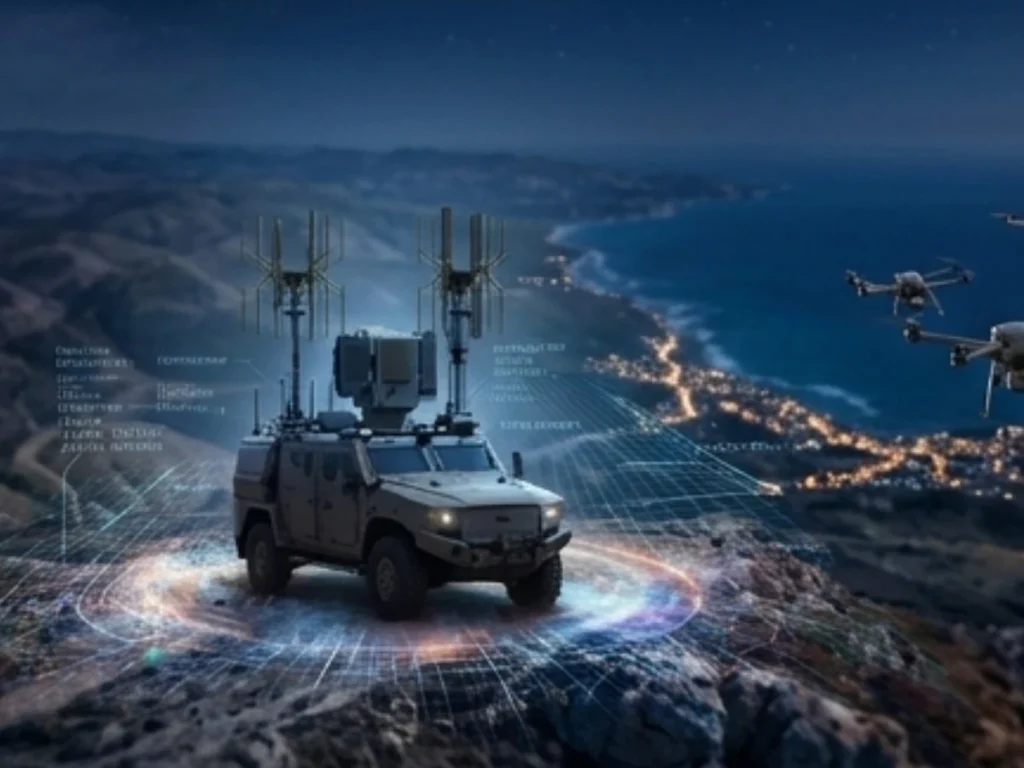
Electromagnetic warfare (EW) constitutes the strategic utilization of the electromagnetic spectrum to secure operational advantage within contemporary military environments. It provides the capability to disrupt, deceive, and safeguard electronic systems operating across highly contested and congested battlespaces.
Within military operations, EW facilitates the systematic degradation of adversary communication and navigation infrastructures. Such effects are executed through synchronized offensive and defensive actions across air, land, maritime, space, and cyber domains. Core functional elements encompass electronic attack techniques, notably jamming, which reduce signal integrity, availability, or reliability to deny effective usage.
In addition to denial mechanisms, EW systems incorporate advanced spoofing methodologies designed to manipulate or falsify inputs to sensors, communication channels, and positioning systems. Concurrently, friendly forces employ EW capabilities to ensure the protection and integrity of C4ISR (command, control, communications, computers, intelligence, surveillance, and reconnaissance) architectures.
Electronic Support Measures (ESM) deliver persistent detection, interception, identification, and analysis of electromagnetic emissions in real time. These functions significantly enhance situational awareness and compress decision-making timelines at both tactical and operational levels.
The importance of electronic warfare
Electromagnetic warfare (EW) prioritizes electromagnetic protection (EP). It protects systems from hostile electronic attacks and preserves mission-critical functions. Moreover, modern doctrine integrates EW into joint and multi-domain operations. As a result, forces coordinate effects across unified structures.
Advanced sensor arrays and high-fidelity signal processing drive EW effectiveness. These technologies enable precise spectrum surveillance and signal classification. Additionally, they support adaptive responses in dynamic, contested environments. Meanwhile, hybrid warfare and cyber domains increasingly converge. Therefore, units synchronize electromagnetic operations tightly. In parallel, personnel train to perform under high-pressure, time-sensitive conditions.
Rapid technological innovation and adaptive threats drive EW evolution. Consequently, defense organizations invest heavily in research and development. They aim to achieve spectrum dominance and improve electronic resilience. At the same time, critical infrastructure and satellite communications depend on strong electromagnetic shielding. They also require efficient spectrum management. Furthermore, intelligence and cyber units coordinate efforts to produce integrated operational effects.
Armed forces maintain readiness through continuous training and simulations. They also conduct frequent spectrum warfare exercises. As a result, they counter evolving adversarial tactics effectively. However, adversaries constantly develop new countermeasures. Therefore, forces must continually refine EW strategies and technologies.
Ultimately, forces succeed in electromagnetic warfare by maintaining high operational tempo. They execute missions with precision and sustain superior spectrum awareness and control.